

What changes for the organisation
Your proprietary source code gets AI security review without ever leaving your network.
Security review of your proprietary code, on your own hardware.
What changes for the organisation
Your proprietary source code gets AI security review without ever leaving your network.
How it works
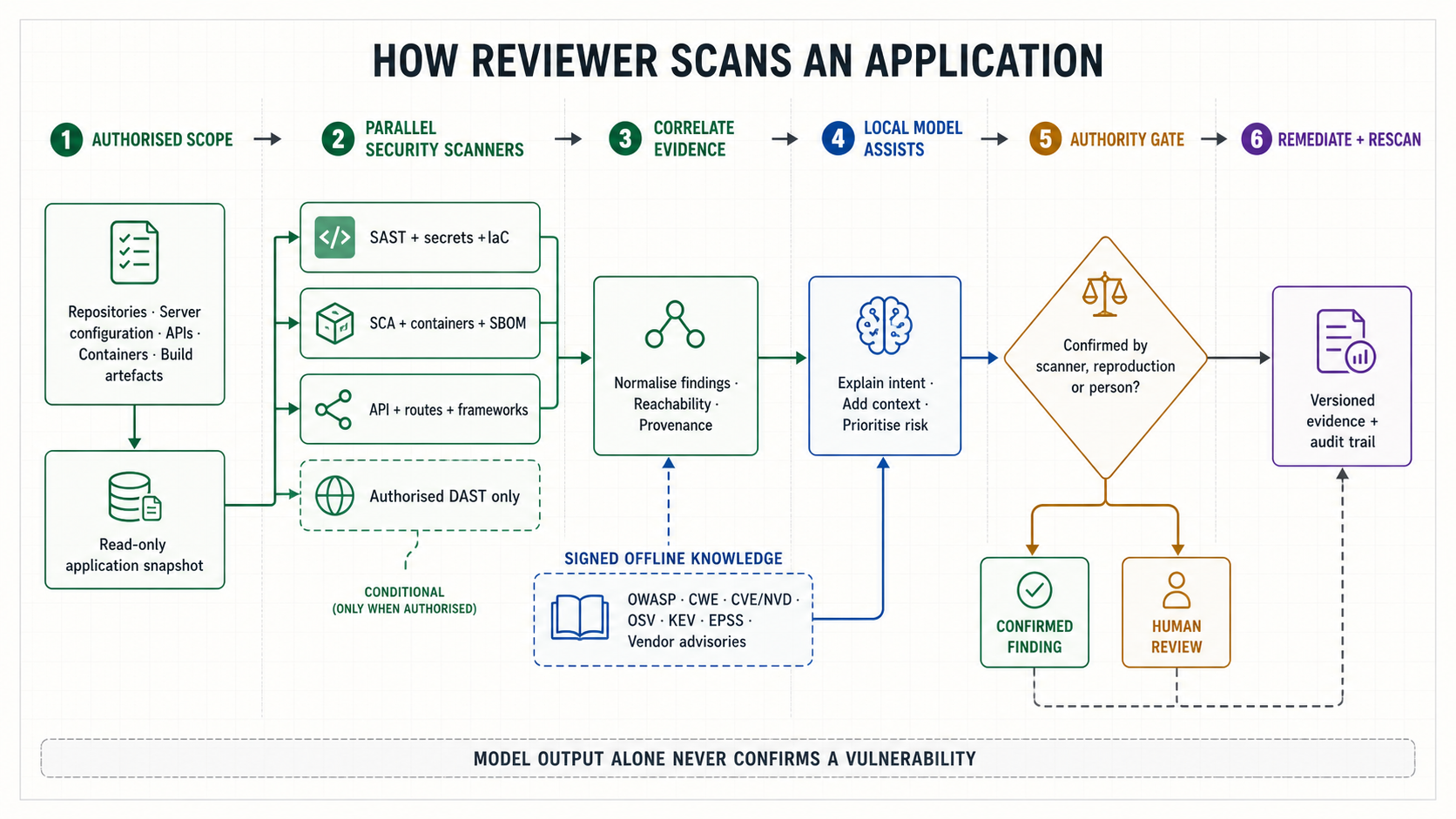
Repositories, pull requests, build artifacts, dependency manifests, API specifications, infrastructure-as-code and deployment configuration are analysed locally. Scanner findings are correlated and explained; vulnerabilities are prioritised by exploitability, reachability, exposure and data sensitivity.
Reviewer is designed for customer-hosted Microsoft IIS and common Linux and Unix application stacks. It examines approved source, dependencies, server configuration, APIs, containers, infrastructure-as-code and build artefacts inside the customer network. Platform support means evidence from named scanners and parsers—not a claim that one model understands every stack equally.
First-wave stack for product evaluation and connector validation.
Coverage depends on the selected engine, language, framework and available artefacts.
A proprietary or less common stack requires an agreed parser, connector and test corpus.
Signed, versioned public-security knowledge packs enter the isolated environment through the governed offline update path. Reviewer retrieves the relevant records when explaining a scanner result or candidate weakness, and cites the source and pack version used.
Top 10 classification, ASVS requirements, Web Security Testing Guide cases, Code Review Guide and defensive cheat sheets.
A stable taxonomy for the software weakness, its relationships and remediation context.
Public vulnerability identity, affected-product metadata and severity context.
Package-aware advisories and affected version ranges across open-source ecosystems.
A strong prioritisation signal when a vulnerability is known to be exploited in the wild.
Exploit-likelihood context; a probability signal, never proof that exploitation occurred.
Product-specific fixes and mitigations from the relevant server, framework and package publisher.
Normalised SAST, SCA, secret, IaC, container and API findings, preferably with SARIF or another declared format.
Retrieval comes before training. Optional LoRA adapters may learn stable security-review behaviour from evaluated, appropriately licensed public material. An advisory can therefore become usable with the next knowledge pack without a new training cycle. Customer repositories, diffs and secrets are not training data by default, and model output alone never confirms a vulnerability.
Scanners supply authoritative signals, offline security intelligence supplies current context, and the local model explains intent and ranks risk. Only a scanner, a reproducible test, or a person can confirm a vulnerability.
The mechanism, not the marketing. If a step below would not survive an engineer's scrutiny, it should not be on this page.
Operating path
Two findings in one diff, produced by two different kinds of authority.
A pull request opens. The Git host adapter delivers the diff, the manifests, and the resolved dependency tree.
Software composition analysis flags a transitive dependency introduced by the bump, matched against the local OSV pack, carrying a known-exploited entry. This is authoritative: a scanner said it, and it is reproducible.
Reachability analysis places the vulnerable function on a path called from the file-upload handler, which is internet-facing. That combination moves it above 40 other open findings.
Reviewing the diff itself, the model notes a second change the title does not mention: an authentication middleware bypass added to a health-check route. It is flagged with file and line, as a candidate — not as a confirmed vulnerability.
The dependency finding is confirmed because a scanner and a public advisory support it. The middleware finding is unconfirmed until a person looks, and it is presented that way.
The developer confirms the middleware change was a debugging leftover. Both are fixed in the same follow-up commit.
What it came to
Neither your source code nor the diff left the network at any point. The advisory data that made the first finding possible arrived on a USB stick last month, signed, and was verified before it was installed.
The authority ladder. Green rungs are authoritative — a rule, a scanner, a sandbox, or a person. Blue is where the model contributes. Amber is where a human decides.
Intent analysis — the suspicious dependency addition, the undocumented privileged path, the debug functionality that should not have shipped, the change that does not match its own commit message.
It is not the source of truth for a vulnerability, and its prioritisation is a recommendation rather than a risk decision.
We will not show you a scripted demonstration of something that does not exist. What we publish instead is the workflow specification, held to the same standard as shipped work: actor, trigger, happy path, exceptions, terminal state, and the audit evidence it must leave. When it is built, this section becomes a demonstration.
Roadmap discovery. Promotion requires a named Git host and scanner formats, plus reproducibility and false-positive-rate targets.