

Platform · Private AI Core
Your Security Data. Your Private AI Core.
A customer-controlled reasoning service for every SentraMind agent crew—deployed inside your environment, sized to your workload, and designed to operate without a hyperscale GPU cluster.
Design-partner roadmap This build contains no model runtime and calls no model — every model-shaped capability reports an explicit “model not configured” state. The architecture, model classes and hardware figures on this page are intended design and sizing targets: not measured results, and not a supported production specification.
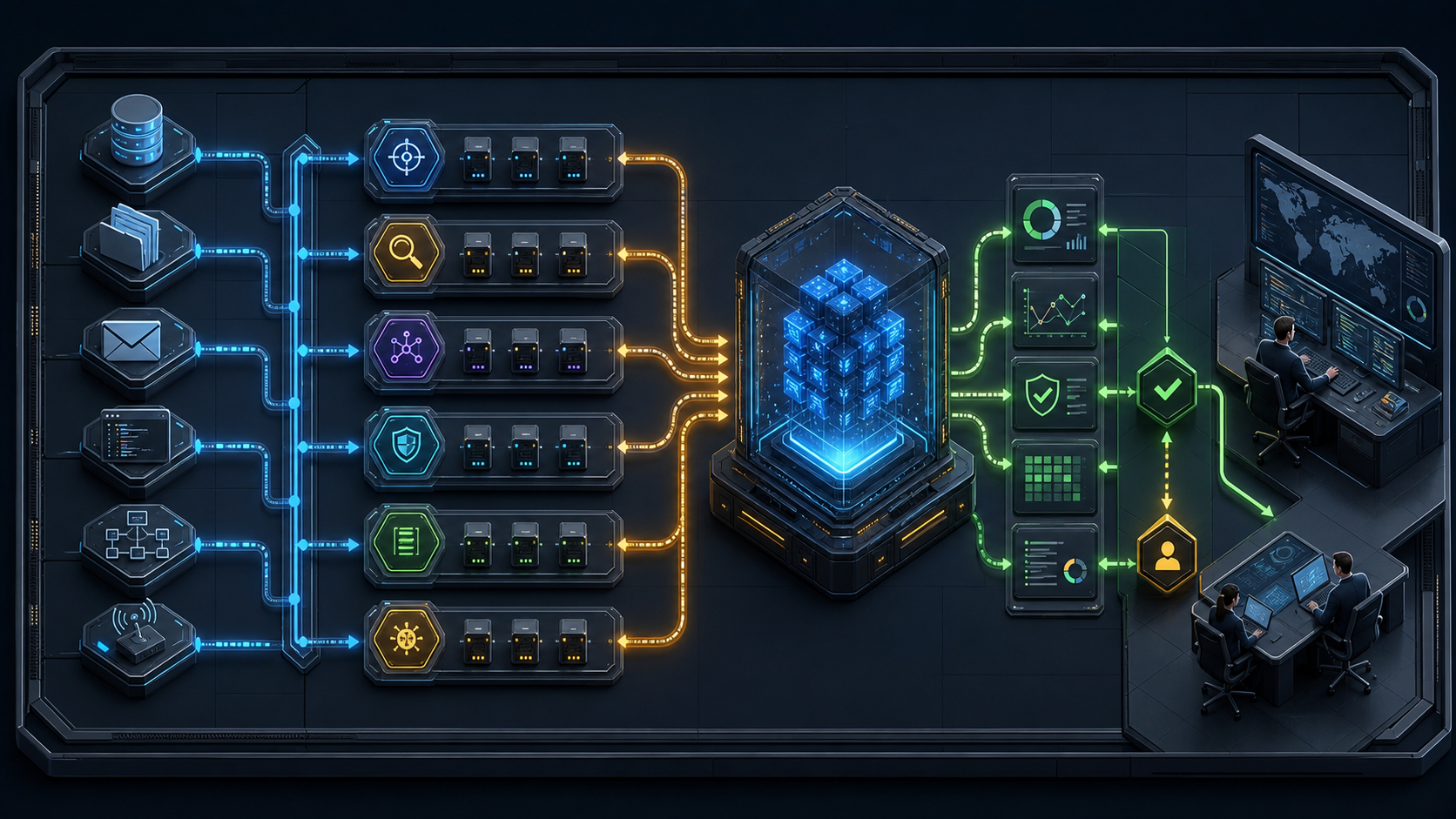
Raw stores remain authoritative. Agents send only the evidence needed for an approved task through policy and access controls.
Customer-controlled environment · no public AI service required for normal private inference
- 01Identify the task
An approved user or agent crew opens a defined security task.
- 02Minimize evidence
Parsers and deterministic detectors select the smallest relevant context.
- 03Apply controls
Access checks, redaction, purpose rules and retrieval permissions are enforced.
- 04Reason privately
The approved model and private knowledge service analyze a bounded request.
- 05Validate the result
Structured output is checked by policy-controlled and deterministic services.
- 06Review and record
Authorized people decide; evidence references, versions and outcomes are auditable.
Why private
The public-AI security dilemma
Investigation evidence can contain material that should not be submitted to an uncontrolled external service.
- 01
Sensitive by nature
Source code, email, identities, configurations, database details and incident records are routine security inputs.
- 02
Customer-controlled processing
Prompts, retrieved knowledge and responses can remain within the deployment boundary and customer retention policy.
- 03
Network independence
Restricted-network and isolated operation can be designed with approved offline updates.
Shared service
One reasoning layer for every agent crew
Specialists use a common governed vocabulary and reasoning service without receiving unrestricted access to one another’s sources.
- 01
Postmaster
Explains possible internal or unintended email data exposure using selected message evidence.
- 02
Reviewer
Interprets code and application findings, relates security references and drafts remediation guidance.
- 03
Correlator
Connects relevant events across approved log sources and prepares investigation narratives.
- 04
Other crews
Future specialists connect through the same authenticated gateway, purpose controls and audit trail.
Practical baseline
Start with the smallest model that meets the task
A planning baseline balances analysis quality, response time, concurrency, power and acquisition cost. Final capacity is established by testing.
- 01
Standard
Quantized 12–14B model, one 24–32 GB GPU, 128 GB RAM and 2 TB NVMe.
Recommended planning baseline—not a performance guarantee - 02
Professional
Quantized 24–32B model on a 48 GB ECC GPU with 128–256 GB RAM.
For stronger reasoning or moderate concurrency - 03
Resilient
Two GPUs or independent nodes where redundancy, separation or higher concurrency is required.
Availability is optional and workload-led
Data residency
What goes where?
The deployment statement records the final retention, audit and export policy; these are the architectural defaults.
- 01
Source data stays put
Raw logs, mail stores and repositories remain in their authoritative source systems.
- 02
Evidence is selected
Only approved, minimized evidence enters private inference; credentials and secrets are excluded or masked.
- 03
Knowledge keeps permissions
Approved internal knowledge is indexed privately and retrieval preserves source access rules.
- 04
Telemetry stays local
Prompts and responses follow customer retention; support exports require approval; training is disabled unless separately governed.
Implementation journey
From discovery to governed operations
The engagement proves fit before production acceptance instead of treating a model name as the solution.
- 01
Discover and size
Confirm tasks, languages, boundaries, concurrency, context, response targets and existing infrastructure.
- 02
Validate and deploy
Benchmark candidate models and hardware, then install the approved release inside the controlled environment.
- 03
Integrate and accept
Connect approved crews, identity and knowledge; complete security, functional and performance acceptance.
- 04
Operate and govern
Monitor quality, apply controlled updates and retain tested rollback paths through the managed lifecycle.
Platform · Private AI Core
Size the system around your evidence and workload
The assessment defines the deployment class, model class, tested capacity envelope, availability design and implementation scope before hardware is committed.