

What changes for the organisation
Attack chains spanning SIEM, EDR, DNS, proxy and VPN get told as one story instead of six alerts.
Reconstructs attack chains across the systems that each saw one piece.
What changes for the organisation
Attack chains spanning SIEM, EDR, DNS, proxy and VPN get told as one story instead of six alerts.
How it works
Your existing SIEM, IDS and anomaly engines do the high-volume filtering. The LLM receives bounded, structured event groups — never raw packets or every log line — and reconstructs the chain with ATT&CK mapping and cited supporting evidence.
Correlator is designed for selected, security-relevant events already produced by your on-premises estate and security stack. Connectors parse each source into a canonical event model while retaining the original event identifier, timestamp, host and provenance, so a narrative can always point back to evidence.
Coverage categories and logging principles are informed by MITRE ATT&CK detection knowledge, OWASP security-logging guidance, NIST log-management guidance and vendor documentation. These sources guide schemas and evaluation; they do not turn model output into authoritative evidence.
Deterministic tools retain detection authority. The local model connects cross-source clues, cites the evidence for every step and names the gaps; an analyst decides what to investigate or deploy.
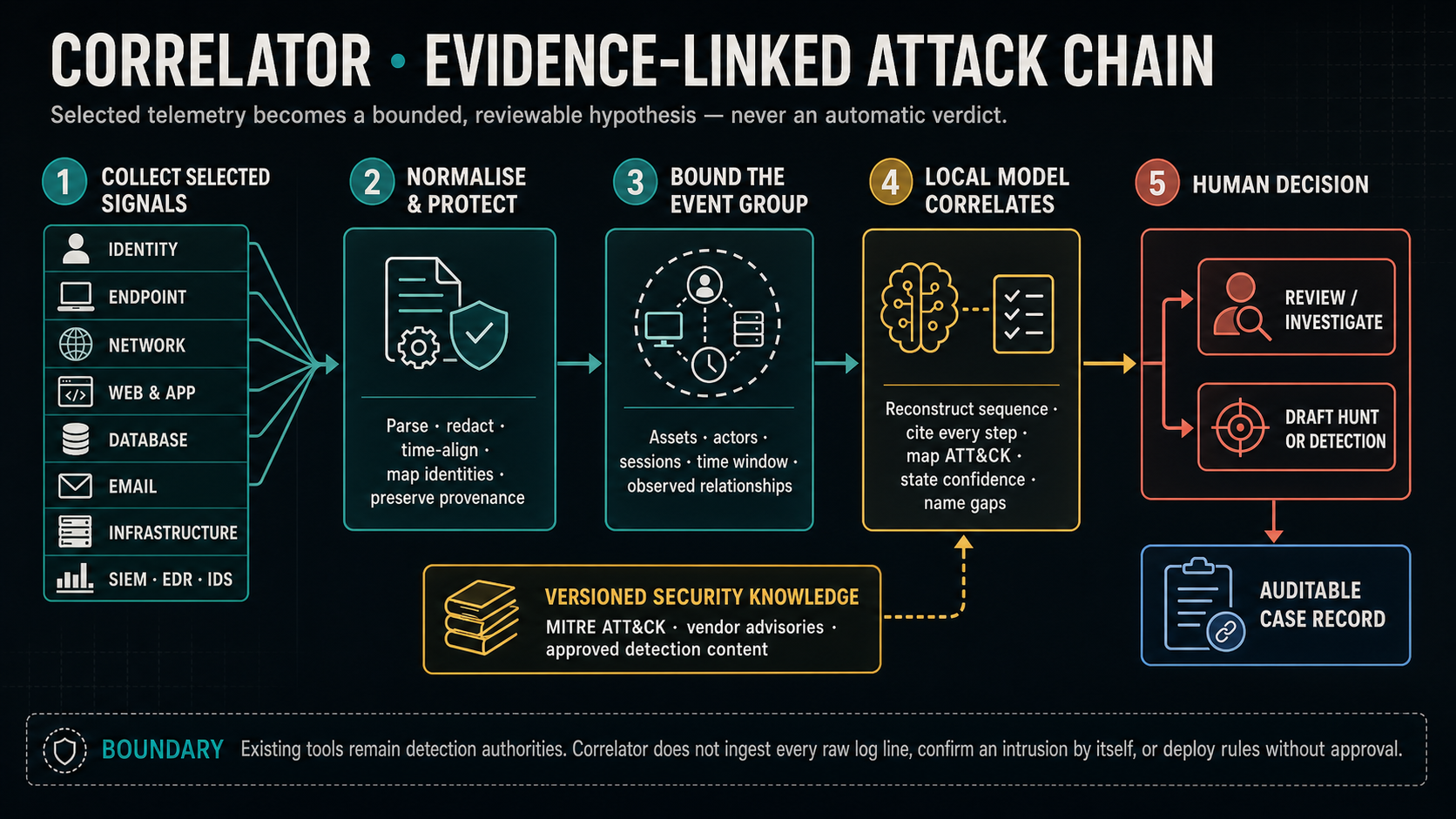
The mechanism, not the marketing. If a step below would not survive an engineer's scrutiny, it should not be on this page.
Operating path
Every tool behaved correctly. Every threshold was set sensibly. Nothing alerted.
Periodic small outbound connections to one destination — comfortably beneath the volume threshold that would have raised anything.
The same destination resolved every nine minutes, jitter under four percent. Regular, but not individually remarkable.
A user-agent string inconsistent with any browser build deployed in the estate. On its own, a curiosity.
The parent process is a signed binary, so no behavioural alert fired. Correct behaviour by the tool.
Correlator groups the four into one structured set and returns a beaconing narrative citing all four sources, with confidence stated and method named.
No endpoint telemetry ties the network handle to the process. One step of the chain is unproven, and the output says so rather than closing the loop with an assumption.
The drafted hunting query runs; the SOC confirms with the sandbox; the incident is opened by a person.
What it came to
No single tool was wrong and no threshold was misconfigured. The story was simply distributed across four of them, and nothing in the stack was responsible for reading it as one sentence.
The authority ladder. Green rungs are authoritative — a rule, a scanner, a sandbox, or a person. Blue is where the model contributes. Amber is where a human decides.
The narrative across sources — the sentence that connects a VPN login, a DNS lookup and an outbound transfer into one hypothesis with its evidence attached.
It cannot independently establish that an intrusion occurred, and it does not replace the SIEM or the IDS.
We will not show you a scripted demonstration of something that does not exist. What we publish instead is the workflow specification, held to the same standard as shipped work: actor, trigger, happy path, exceptions, terminal state, and the audit evidence it must leave. When it is built, this section becomes a demonstration.
Roadmap discovery. Retention, normalization, throughput and data-source licensing are connector-specific requirements to define before implementation. Promotion requires log-ingestion lag and volume targets plus correlation-precision measurement.